Showing posts with label book review. Show all posts

Friday, July 29, 2011

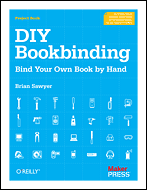
Review: DIY Bookbinding


DIY Bookbinding
Bind your own book by hand
By Brian Sawyer

is a short (32 pages) article that teaches you how to bind your own books. Whether you find the idea of binding your own books exciting, or you just want a way to preserve your magazines or other printed material, DIY Bookbinding is a book for you.

Brian Sawyer takes you step-by-step through the bookbinding process, from pulling the pages out of a perfect bound book, all the way up through putting in the endsheets. If you're interested in binding your own books, this book has some great information.

The Good
High quality photos and step-by-step instructions make this guide an excellent how-to. The amount of literature available on the internet dealing with book binding is somewhat limited, so the concentrated information here is quite welcome.

The Bad
I wished this article had more illustrations to accompany or replace some of the photographs. The important aspects of the photos ended out obscuring some of the more important details. Of course that means that there are reference images, so that's a good thing.

The Bottom Line
If you're interested in book binding, whether as a hobby, or just to preserve your magazines or other papers, you should buy this book. With the information in this guide, you can easily make back the $5 cover price, or make presents (journals, personalized books, etc.) of a high enough quality that will make this a good buy.

Thursday, July 14, 2011

Book Review: The Book of Ruby


The Book of Ruby, by Huw Collingbourne, is an interesting introduction to the language of Ruby. And a great choice for the advanced programmer who wants to pick up Ruby.

If you check out the Table of Contents you can see that after the introduction to Ruby, the author provides plenty of instruction on how Ruby deals with classes, and then moves to strings and other common data types. After discussing data types, The Book of Ruby goes on to present different flows (loops, if-else statements) and grouping (blocks, methods) and then drops into a fairly powerful Ruby construct called Symbols. You'll also find information on marshaling data, and storing it to disk either by marshaling or YAML data.

Overall this was an interesting book - I liked having several small programs to work with, which let you focus on a single concept. My biggest issue with this book is jumping straight from an introductory "Hello World!" program into classes. For the novice programmer, this approach is probably like jumping in the deep end and I would have to recommend picking up another book to learn how to program. When reading The Book of Ruby you won't be entertained or bored, merely informed. I'd say this book is best suited for reference material, and would be a great addition to your reference library.

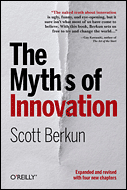
Book Review: The Myths of Innovation


The Myths of Innovation, by Scott Berkun, is an interesting read. In this book he argues that the word innovation is overused, and that true innovation is a hard thing. He provides examples of true innovators, (Ford, Edison, Jobs, Brin and Paige) and explains how we build myths around the men.

I really enjoyed Berkun's take on the term innovation. He does a wonderful job of persuading the reader that innovation isn't just something that you do on a daily basis, but that it's more of a process. I found his arguments compelling. There were many thought provoking points, and I think my favorite was "Creativity has more to do with being fearless than intelligent or any other adjective superficially associated with it." His arguments and examples helped me to sort of "meta-think", or think about the ways that people think about the world. I think the most eye-opening parts of the book are when he tries to shed the aura of mystique from around the innovators of the past and the present. One of the points he made is that there's no magic moment of innovation - as humans we just build up the idea that there was one magic moment when Bell invented the telephone, or Newton discovered gravity, or Copernicus developed his heliocentric theory.

I think that anyone who has ideas should read this book. If you want to invent something, or be the next Mark Zuckerberg, then you should read the Myths of Innovation. If you are a knowledge worker (programmer, artist, etc. - or if you just want to be one), you should read this book. The Myths of Innovation was a good read, and helps pull mythic figures of the past off their pedestals.

Wednesday, January 19, 2011

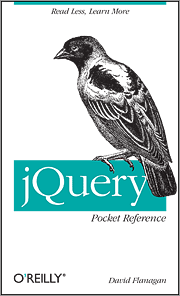
Book Review - jQuery Pocket Reference


jQuery Pocket Reference, by David Flanagan leads the reader through a lot of the basic jQuery principles. This book is for those who are fairly familiar with JavaScript already, and are interested in the jQuery library, or those who may have some experience with jQuery and want a solid guide to its features, as well as a language reference.

In jQuery Pocket Reference, you will be introduced to the basic concepts of jQuery which includes the some of the what and why behind jQuery. You will also learn how to modify DOM element attributes, add and remove elements from your page, work with events, animate your elements, working with Ajax, some utility functions, how to extend jQuery, and you will also learn some about the jQuery UI library that allows you to automate the building of a user interface. Then, of course, you have the actual language reference.

I was again impressed by Flanagan's writing in this book. I had only heard of jQuery before I got this book, but I have some familiarity with JavaScript (and several years experience with other languages), and this book has been a great introduction to jQuery and I'm sure the reference will come in handy later this semester in my Web Technology class. If you're looking for a great reference for jQuery, you should buy this book.

Friday, January 14, 2011

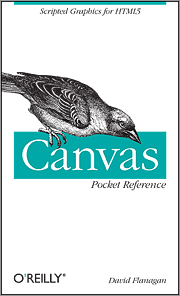
Book Review - Canvas Pocket Reference


Canvas Pocket Reference, By David Flanagan, is a short and sweet little book that covers the HTML5 canvas element, made famous by the likes of Mr. Doob's Harmony Sketch tool.

In this book, David Flanagan assumes you are familiar with HTML, CSS, and JavaScript, and focuses solely on the canvas element and all the things you can do with it. The first chapter is an introduction to all the ways you can draw on a canvas, with code examples accompanying each description. If you need a refresher or haven't really been exposed to the canvas element, this chapter will serve you well. I only learned about the canvas element this previous summer and never really experimented with it. But this chapter was all I needed to feel comfortable using all of the different canvas drawing methods.

The second chapter is just a reference for the canvas element and all of its associated methods. In alphabetical order, it's quite handy if you just need to remember what the parameters for bezierCurveTo() are, or what the name of that function is that closes a path.

At $15 for the ebook+Dead tree version, this is a must-buy for any web developers library. Sure, you can find most of the information on the web, but this is a handy guide that you can keep on your desk or in your laptop bag (or just on your computer). I enjoyed reading this book, and I look forward to using it to help me develop my own canvas apps.

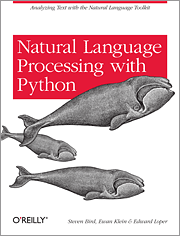
Book Review - Natural Language Processing with Python


Natural Language Processing with Python, By Steven Bird, Ewan Klein, Edward Loper, introduces the Pythonista to the field of NLP, the language processing enthusiast to Python, and everyone else to both. In this book, the reader is introduced to both Python and some language processing by page five. Rather than teaching Python first and then Natural Language Processing, this book alternates between the two, showing live examples in Python code when a language processing concept is mentioned. When programming concepts are needed or useful, they are explained - usually in the context of "How can this help me better process text?".

After a solid introduction to Python and some language analysis tools, the reader is taught how to load corpa (large collections of text, if you're new to NLP like I am) - both those provided by the NLTK (Natural Language Tool Kit) team, as well as the users own corpa. Then the next few chapters alternate between Python and language processing. The reader will by no means finish with a complete understanding of computer science, but they will be equipped with most of the knowledge of programming that they will need to do most language processing tasks with Python and the NLTK.

I was fairly impressed with this book - I originally saw it at the most recent Python Arkansas conference as a door prize and it looked interesting to me. Someone else was the lucky winner, however, so when I had the chance to review this book I jumped at the opportunity. This book was very well written, in a style that had just the right mix of code samples to try out, conceptual information, and challenging exercises. That's probably why it has "been adopted in courses in dozens of universities" (p xiv). As they explain in the introduction, this book is not a reference book for either Python or Natural Language Processing. If you want more in-depth coverage of either of those you're probably best off looking elsewhere. However, if you know Python and want a great introduction to language processing, or if you know some language processing and are interested to see what Python has to offer you, this book is a must-buy.

Friday, January 7, 2011

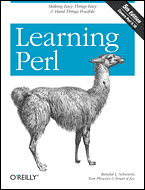
Book Review - Learning Perl


Learning Perl, by Randal L. Schwartz, Tom Phoenix, brian d foy is an entertaining and well-written book that will take you from knowing at least a little bit about programming, to knowing a lot about Perl.

Learning Perl starts off with a basic introduction to Perl, with basic data types, subroutines, and input/output (including files). Then you are introduced to more advanced topics such as hashes, regexes, Perl modules, file tests, and directory operations. In this book you will find fairly in-depth discussions on each chapter, with a set of exercises at the end that should take the novice programmer about 45 minutes to complete. The exercises are well written and help the reader retain the information that was presented in the chapter.

I picked up Learning Perl for the obvious reason - I wanted to learn Perl! And this book was a marvelous introduction to the language that says TMTOWTDI (pronounced Tom Towdy). Rather than a horribly dry book full of obfuscated examples, I was surprised at how entertaining the read was. The examples were somewhat contrived (using Flintstones characters, for example), but they were perfect for teaching the principles in each chapter. If you make an honest effort to go through this book and finish the exercises, you can easily learn a lot of Perl in a week. You may not be a Perl whiz, but when you see something like

while (<>){ chomp($_); print $_; }


rather than being utterly confused at the cryptic symbols, you'll have a fairly good (if not great) idea about what's going on.

This book is a must-have for anyone who wants to learn Perl.

Monday, January 3, 2011

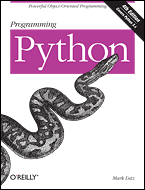
Book Review - Programming Python

Programming Python, by Mark Lutz is a serious book for those serious about programming in Python. A follow up to his book Learning Python, Programming Python covers none of the basics, but is entirely devoted to practical applications of the Python standard library. He starts off with representing records, and persistent storage, then introduces classes, console interaction, GUI programming, and web interfaces. The next several hundred pages provide practical examples of using system tools, file handling, parallelism, GUIs, networks, CGI scripting, databases, and basically anything else you can do with Python.

As an avid Pythonista, I had heard of this book a few times on mailing lists, and the list price of about $70 USD is probably the right price for this book if you're interested in using Python in a practical sense. However, for the current price of $40, this book is a steal. If you know the basics of Python and are wondering, "Now what?", you should buy this book.

Saturday, January 1, 2011

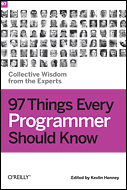
Book Review - 97 Things Every Programmer Should Know

97 Things Every Programmer Should Know, by Kevlin Henny is a collection of CC-Licensed essays containing... well, you read the title! Topics range from beautiful code, to testing and automating tasks, to interacting with customers/clients. Just about every facet of the professional life of a programmer is covered in this book.

As a Senior in a Computer Science program, I found the essays to have extremely good advice. Probably the best essay was the Boy Scout Principle, though they were all pretty helpful. For the seasoned developer, these essays probably won't bring anything new, especially if you've looked into some of the XP methodologies. However, for the novice programmer these principled presented here will hopefully make for a better programmer. The only criticism I have is that while this book is certainly a useful one to have around, though the $29(USD) list price is a little on the steep side ($10-15 seems more reasonable, although I don't know what printing costs these days!)

Wednesday, December 22, 2010

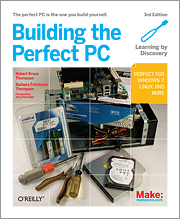
Review - Building the Perfect PC


Building the Perfect PC, by Robert Bruce Thompson and Barbara Fritchman Thompson, is the perfect introduction to the world of building your own computer. Whether you're looking for a general purpose computer built mainly for playing Farmville, or you want to build a web server, or a MythTV DVR computer, or you want a system that can play Crysis on max settings, this book will teach you how. The Thompson's introduce you to the world of PC building by explaining why you should want to build your own (and you should!), and then proceed to demystify the process of selecting components and putting them together to build your perfect PC, designed specifically for what you want to do.

Having built my own computers (and having cobbled together a few from various dead PCs), I can say this guide is an invaluable resource. The money that you will save buying an equivalent pre-built PC will probably be much greater than the cost of this book, so if you're in the market for a new PC you should buy this book and build your own. You'll be able to custom tailor your PC to your individual needs and desires, that will be a much better buy than anything you can find pre-built.

Bottom line: You should buy this book if you need a new PC soon.

Tuesday, December 14, 2010

Review - Make: Electronics


Make: Electronics, by Charles Platt, is an incredible book for anyone who is curious about electronics. This book guides you through a variety of experiments, beginning with simple experiments like "tasting" electricity and making a battery with lemons, lighting an LED with a battery, and then quickly (but not too quickly!) moving into more advanced topics such as using relays, creating timers, soldering, integrated circuits, electromagnetism, stepper motors, and even some PICAXE programming. It has high-quality color pictures and diagrams, and great explanations.

Make: Electronics blows most other electronics introductions out of the water. I was given a copy of Electronics Projects for Dummies, but that book was so dry I couldn't bring myself to try any of the projects. Charles Platt writes an incredibly informative and entertaining book - if you are looking to buy a beginners guide to electronics, your search is over. If you are buying this book for someone with just a spark of curiosity about electronics (even yourself), after they finish this book, they just may be addicted. This book is excellent - 5/5!

Monday, December 13, 2010

Review: JavaScript: The Good Parts


JavaScript: The Good Parts, by Douglas Crockford.

Mr. Crockford writes a fine book for anyone who uses or needs to use JavaScript - ever. He quickly presents his view on JavaScript, that it can be a powerful and expressive language, but that it has some rather large warts. The author quickly leads the reader through an introduction to JavaScript, and shows how to avoid the major pitfalls inherent in JavaScript.

This book is fairly terse and not so much a learn-JavaScript book as it is a guide. The beginner embarking on a journey through the JavaScript jungle should certainly purchase this book as a companion to another more beginner-friendly book, to help clarify (and possibly correct) points being taught. I enjoyed JavaScript: The Good Parts, and recommend it to any one who works with or will work with JavaScript. It will make a big difference. Before taking a look at this book, I certainly would have happily criticized this language, but the author makes several good points and made me reassess my opinion of JavaScript. If I am ever in a position where I develop with JavaScript, you can be sure that this guide will be by my side, helping me to avoid the many pitfalls and use JavaScript to its full effectiveness.

Tuesday, November 23, 2010

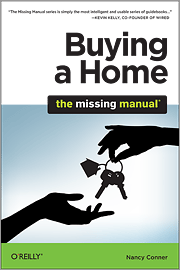
Review - Buying a Home: The Missing Manual

Buying a Home: The Missing Manual

by Nancy Conner


Are you thinking about buying a home? Then this book is for you! Buying a Home: The Missing Manual walks you through everything you need to know about the process of purchasing a home, from selecting a real estate agent, to closing (and even a little beyond). Having started the process of buying a home a few times before, I can honestly say I wish I had this book back then. I would have avoided some of the pitfalls that plagued both of my experiences. I didn't even know the questions to ask, and Buying a Home gave me questions to ask and answers to some questions I didn't even know to ask.

I seriously recommend this book to anyone who is contemplating home ownership - whether you get the digital or dead tree version, if you think you will buy a home in the future, Buying a Home: The Missing Manual is a wise investment.

I review for the O'Reilly Blogger Review Program